Always Working, Never Home: The Architecture, Not the Calendar
You answer the email at 7am. You answer another at 9pm. You are in the room with your family and somewhere else entirely. You promise yourself next quarter is different. It never is. You call it commitment. It is something quieter. This is Silent Collapse™ — the structural erosion of identity beneath intact performance. The numbers hold. The person holding them is rarely home, even when the body is. If you have carried this without a name for it, start with Read The Manifesto.
Table of Contents
Key Takeaways
The calendar is not the problem. The architecture is. You are always working because the company routes every decision through you.
Being always-on is a design flaw, not a discipline flaw. No habit fixes a business built to need your presence.
Top leaders average well over sixty hours a week. The hours are a symptom of a single point of failure: you.
Freedom is engineered. Build the systems that decide without you, and the hours fall on their own.
The Definitive Answer
When you are always working and never home, the cause is rarely weak boundaries or poor time management. The cause is structural: you built a company that runs through one nervous system — yours. Every choice routes back to you, so the work never ends. Redesign the architecture, and the hours fall without a single motivational push.
The Hidden Pattern Under the Always-On
For years, one equation kept you safe. If I touch it, it works. The business rewarded the reflex. Every fire you caught taught your nervous system the same lesson: presence equals control, absence equals risk.
So the phone stays on. Research on the always-on executive is blunt about the cost: studies summarized by IMD find chronic stress cuts strategic thinking by close to forty percent. You are not sharper for being reachable at all hours. You are duller, and the company inherits the dullness.
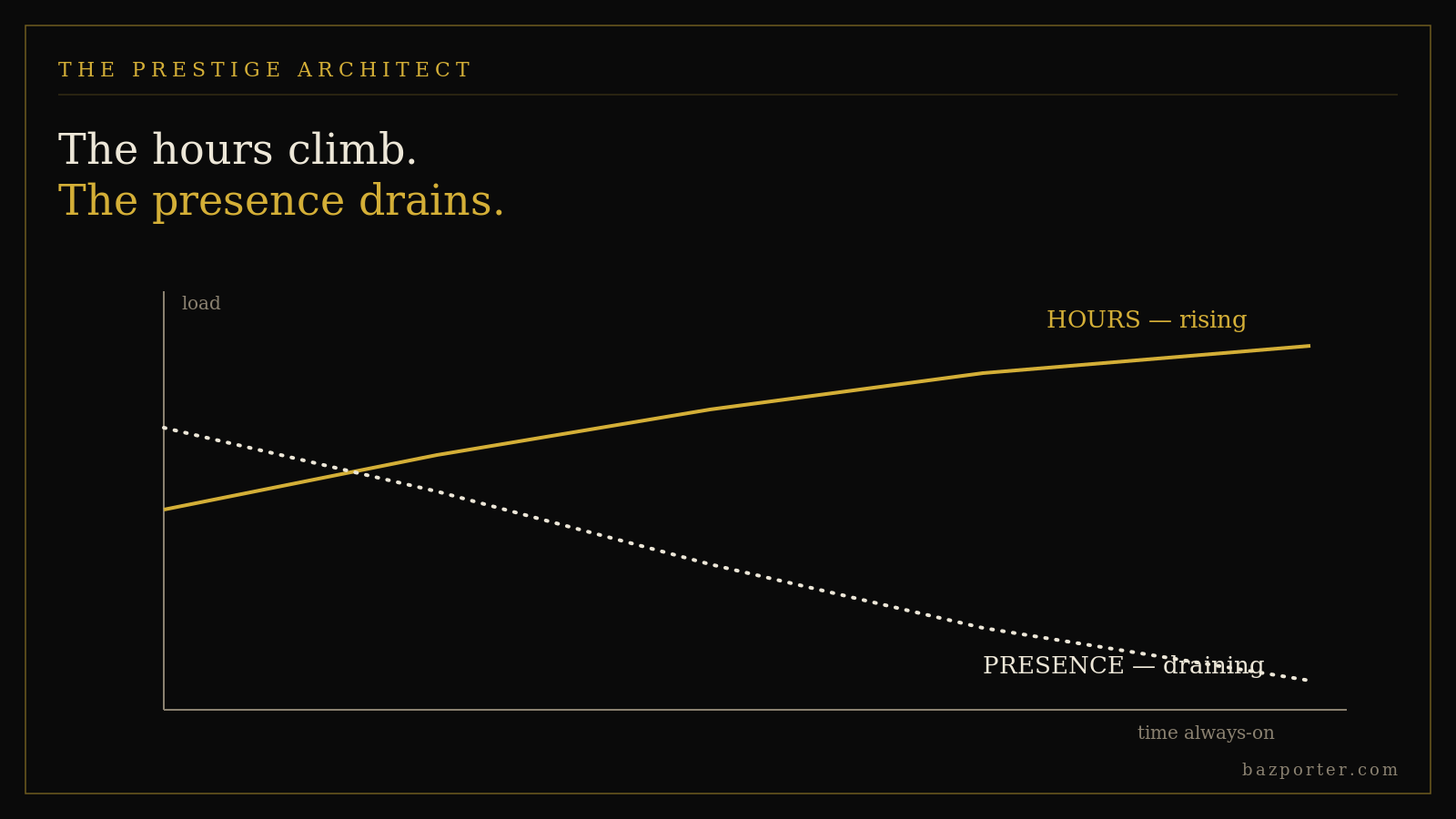
This is the architecture of Silent Collapse™. The output holds. The team holds. The home quietly empties of you while your body sits in it. Harvard Business Review's work on always-on culture names the mechanism: organizations reward visibility over impact, so leaders equate long hours with loyalty and never question the design underneath.
You are not overworked. You are over-architected — the business runs through you because you built it to.
Name that, and the guilt loses its grip. You are not failing at discipline. You are succeeding at a design that was never meant to hold a life. If you want the deeper map of this pattern, the Sovereign Leadership Resource Hub holds it.
The RAMS Reframe: Five Pillars of a Company That Runs Without You
The RAMS Framework™ rebuilds the leader before it touches the schedule. It runs on the nervous system and the business at the same time, because both run on the same architecture. Five pillars: Results, Attitude, Authenticity, Mastery, Systems. Here is how each one moves an always-on founder toward a company that holds itself.
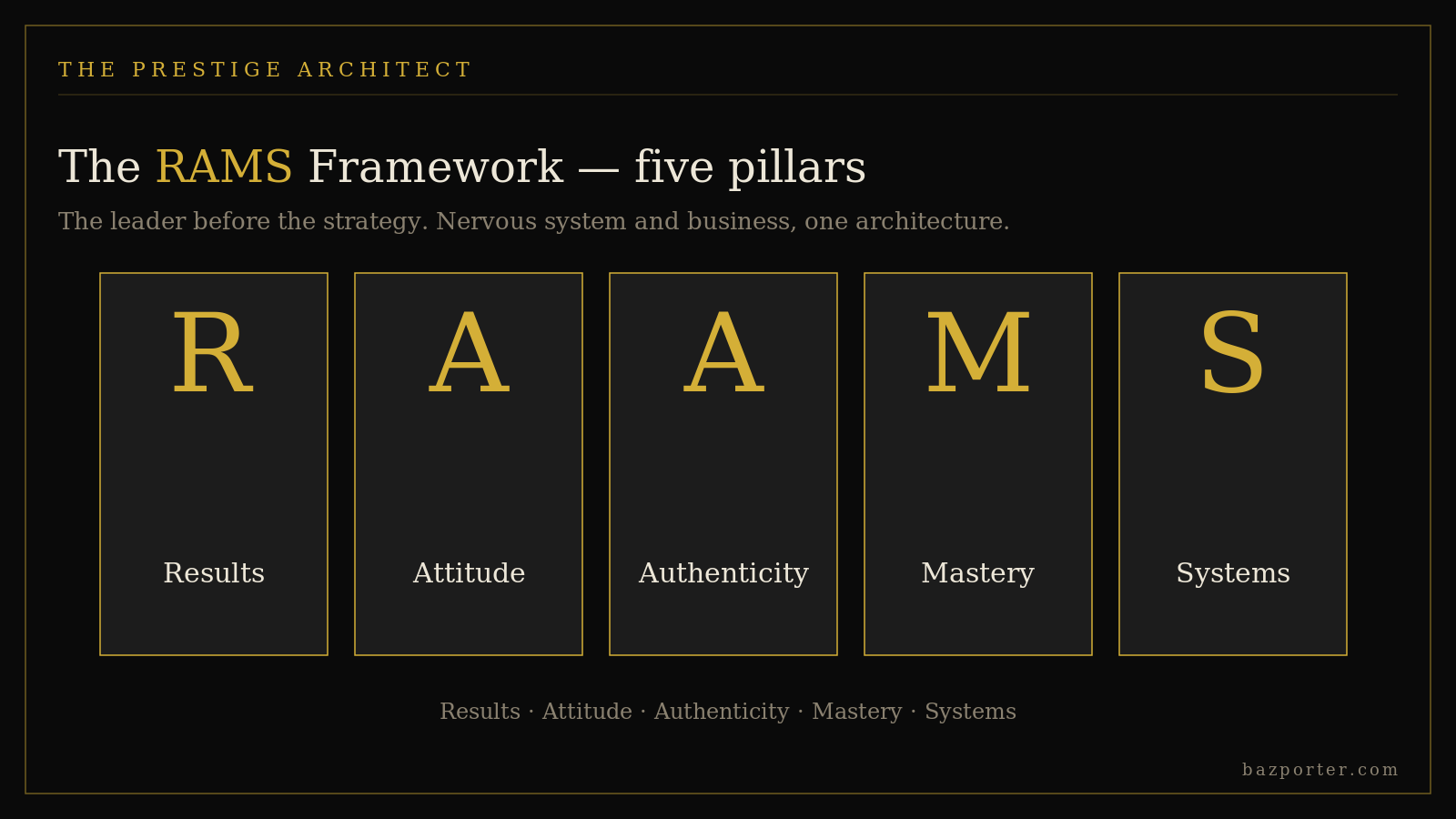
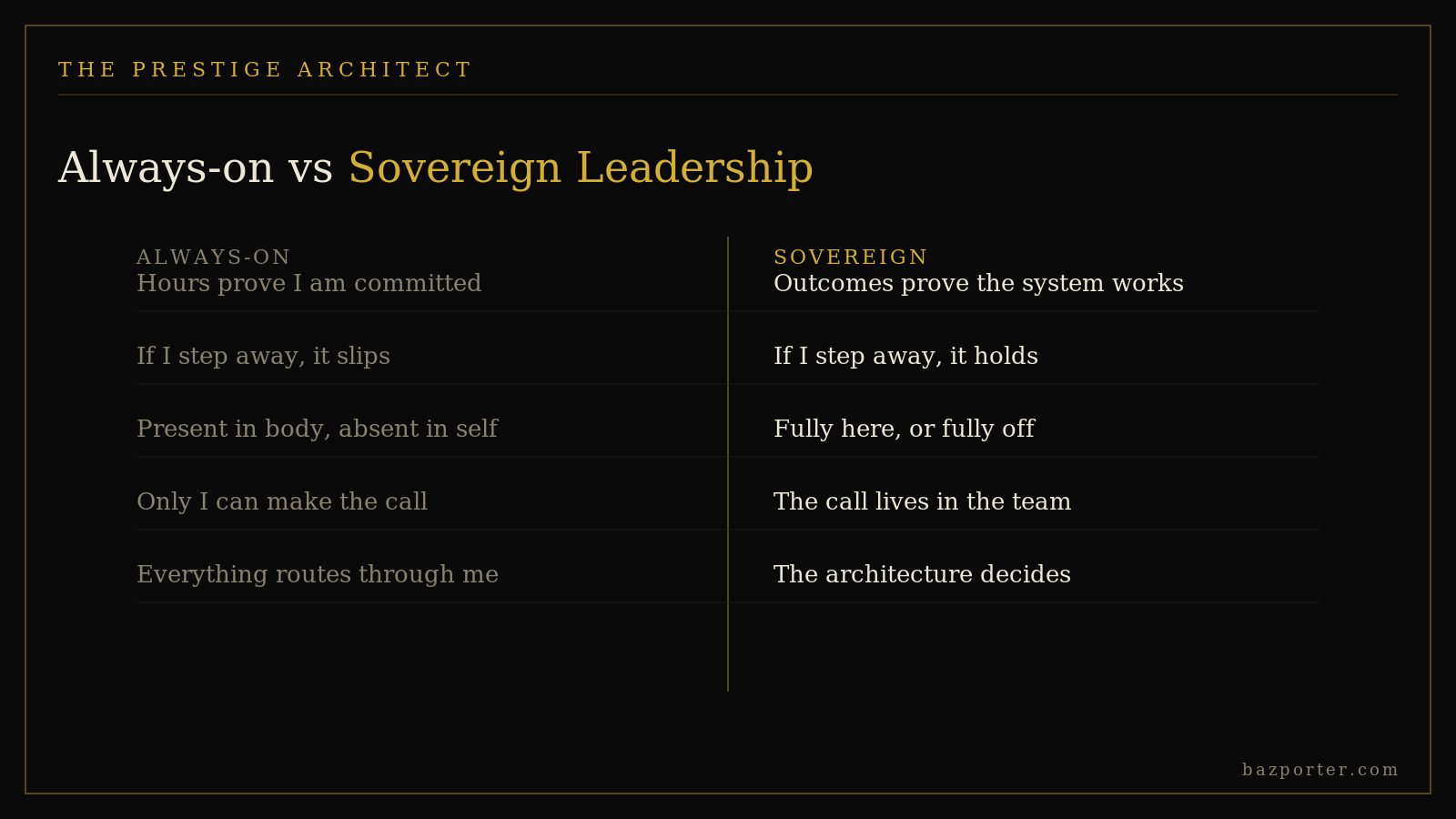
PillarAlways-On FounderSovereign Leadership™ ResultsHours prove I am committedOutcomes prove the system works AttitudeIf I step away, it slipsIf I step away, it holds AuthenticityPresent in body, absent in selfFully here, or fully off MasteryOnly I can make the callThe call lives in the team SystemsEverything routes through meThe architecture decides
Collapsed founder vs Sovereign Leadership™ — the five pillars:
Results. Always-on: hours prove I am committed. Sovereign: outcomes prove the system works.
Attitude. Always-on: if I step away, it slips. Sovereign: if I step away, it holds.
Authenticity. Always-on: present in body, absent in self. Sovereign: fully here, or fully off.
Mastery. Always-on: only I can make the call. Sovereign: the call lives in the team.
Systems. Always-on: everything routes through me. Sovereign: the architecture decides.
Results — The Output and Identity Gap
You measure worth in hours logged, not outcomes shipped. That gap keeps you at the desk long after the value is done. When time-in-seat carries identity, leaving the chair feels like leaving yourself.
Count outcomes, not hours. A result delivered in two focused hours beats ten reactive ones.
Audit one week. Mark the hours that moved an outcome versus the hours you logged to feel needed.
Operational rule: if your presence changes nothing about the outcome, your presence was a habit, not a requirement.
Attitude — Where the Collapse Lives
Attitude is the internal operating system — the story running under every decision to stay late. For the always-on leader, the story is it slips the moment I look away. That story is old wiring that once kept the company alive. It is not a verdict on today.
Command decision: name the story, then test it. Step back from one domain for a week and watch. Most of the time it holds. The fear was residue, not forecast.
Authenticity — The Private and Public Divide
At dinner you nod while your mind runs the P&L. To the team you look calm; inside you are scanning for the next fire. That gap — between the self that is present and the self that is performing presence — is the engine of Silent Collapse™. The wider it grows, the more of your life you spend in neither place fully.
Closing the divide is not a scheduling trick. It is alignment. Fully here, or fully off — never the gray middle that drains both.
A leader who is everywhere is nowhere. Presence is not hours. It is the absence of the divided self.
This is the work most leaders skip, and it decides whether the hours ever come down. If this is naming something you have carried without words, Take the Silent Collapse Diagnostic.
Mastery — Skill Versus Sovereign Capability
Skill is what you can do. Sovereign capability is what the company can do without you in the room. The always-on leader confuses the two, so they stay in every room — and starve the team of the reps that grow past them.
Make decisions beside your people, not for them. Calls made with you become calls made without you.
Reward the independent call. Every decision they own is an hour you no longer carry.
Systems — The Architecture That Frees You
The calendar is not the problem. The architecture is. An always-on leader has usually built a company that routes every decision through one nervous system — theirs. The fix is structural. You design clear decision rights, escalation paths, and defaults, so the business decides without waiting for you.
Operational rule: a company that needs your presence is not an asset. It is a second job you cannot quit. Build the systems, and being home stops costing the business anything.
A Client's Return
A founder came in logging seventy-hour weeks, certain the load was the cost of the level. The revenue was strong. The marriage was thin. We did not start with a time-management plan. We started with the architecture routing every choice through one person.
We rebuilt Systems first — decision rights, escalation paths, a map of what truly required the founder versus what only felt like it did. Then Authenticity — closing the gap between the calm public face and the divided private one. Within a quarter the hours fell by a third, and revenue held. The business did not need the presence. It needed the design.
The Architecture of Your Return
Coming home is not a feeling you schedule. It is a structure you build. Sovereignty in the nervous system means the body no longer reads "step away" as "risk" — because the architecture holds the load you used to carry alone. That is engineered, not inspired.
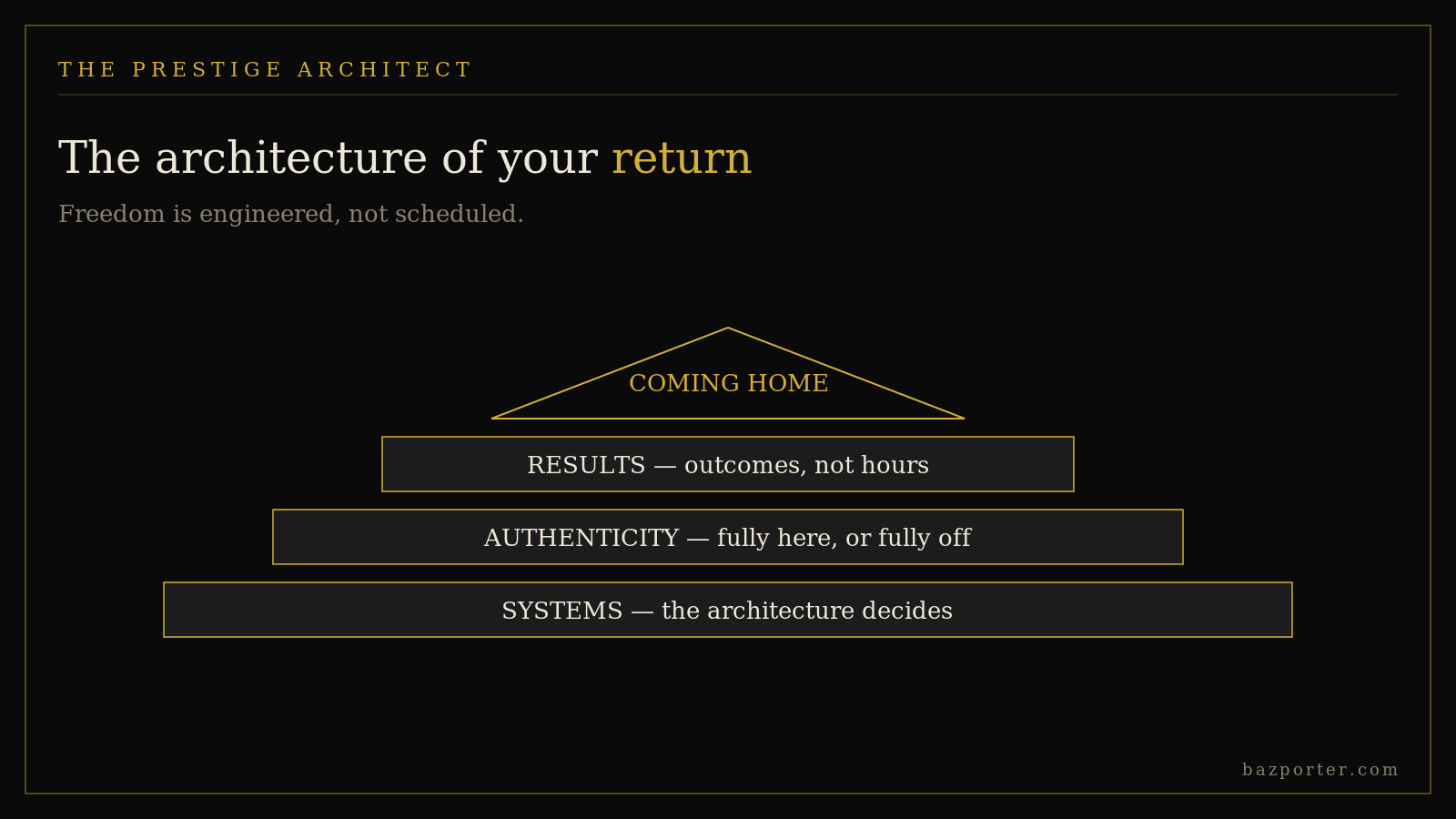
You start by counting outcomes instead of hours. You close the divide between the present self and the performing one. You move the decisions into the system instead of your inbox. Then the hours fall on their own, and home stops being the place you visit between fires. The return is not to less ambition. It is to a company that serves the life instead of consuming it.
This is the work of The Prestige Architect® — building leaders who hold power without paying for it with their lives. If you are always working and want the rebuild done with structure, Apply to Work With Baz.
Frequently Asked Questions
Why am I always working even when there is nothing urgent?
Because the company is built to route every decision through you, so there is always something waiting. The pull is structural, not a discipline failure. Until the architecture changes, the work refills the moment you clear it.
Is this just burnout from too many hours?
No. Burnout responds to rest. This does not, because the issue is not the hours — it is the gap between your output and your identity, and a business designed to need your presence. That is the signature of Silent Collapse™, and it needs architecture, not a holiday.
How do I know if my company depends on me too much?
Audit one week. Mark every decision that genuinely required you versus every one you touched out of habit. If the second list is long, the dependence is in the design, not the workload.
What is the first step to working less without the business slipping?
Set clear decision rights and defaults so routine calls resolve without you. Count outcomes, not hours. Once the architecture decides the small things, your presence is freed for the few that truly need it.
Can I be present at home while still leading at this level?
Yes, once you close the divided self and move the load into the system. Presence is not the absence of work. It is the absence of the part of you that is scanning for the next fire while you sit at the table.
British military veteran. Two-time international bestselling author. Founder, The Prestige Architect®. Host, Rise From The Ashes podcast, C-Suite Network. Boulder, Colorado.