Always Working, Never Home? Fix the Architecture, Not the Calendar
You are at the table. You are not at the table. Your body is home; your mind is still in the inbox. Silent Collapse™ is the name for the leader who is everywhere and present nowhere. You have tried every system. Time-blocking. A stricter calendar. A new app. Each one holds for a week, then the tide comes back in. You tell yourself the fix is better scheduling. It is not. The calendar is not the problem. The architecture is. Most leaders optimize the symptom and never touch the structure underneath. Read The Manifesto before you read the rest.
Table of Contents
Key Takeaways
Cognitive strain, not hours worked, is now the leading driver of burnout (Harvard Business Review, 2026). A calendar manages hours. It cannot manage strain.
"Always working, never home" is a structural problem wearing a scheduling costume. You keep fixing the calendar because the calendar is visible. The architecture is not.
Burnout is rarely an individual failing — it is a system that has no boundaries, no recovery, and no center built in (McKinsey).
The return is engineered through RAMS™ — Results, Attitude, Authenticity, Mastery, Systems — not through a better app.
Why You Are Always Working and Never Home
You are always working and never home because your life has no architecture — only a calendar. A calendar records hours. It does not protect boundaries, build recovery, or hold a center. So the work expands to fill every gap. The fix is not a tighter schedule. It is a structure that decides, in advance, where work ends and you begin.
The Hidden Pattern: Hours Are Not the Driver
Here is the pattern under the exhaustion. For the first time, mental fatigue and cognitive strain have passed raw workload as the leading indicator of burnout (Harvard Business Review, 2026). You are not tired because of the number of hours. You are tired because the mind never closes the loop.
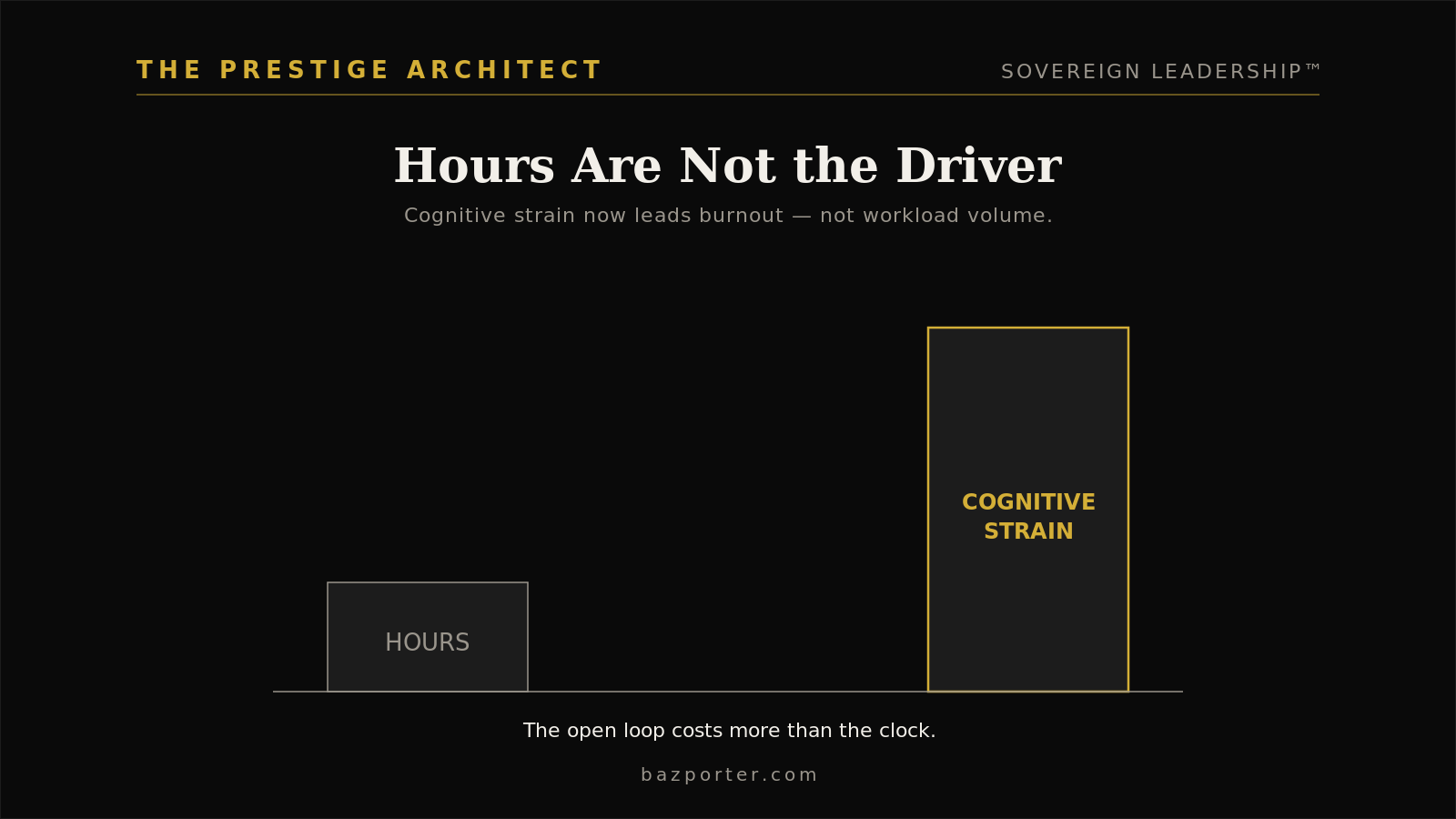
An open loop costs more than a closed one. The unfinished email at dinner is not one task. It is a background process running on the same hardware you are trying to use to be present. This is Silent Collapse™ — the private erosion behind a composed, productive face.
Think of your week as a building with no walls. Everything pours into everything. Work floods the evening. Worry floods the work. McKinsey's research on burnout is blunt about the cause: leaders keep treating a structural problem as a personal-willpower problem, and the structural problem wins every time (McKinsey).
The standard advice tells you to manage your time better. That advice treats an architecture problem as a discipline problem. It will fail for the same reason it always fails. The walls were never built. Start with the Sovereign Leadership Resource Hub if you want the full map.
The RAMS™ Reframe: From Reactive Calendar to Sovereign Architecture
The RAMS Framework™ rebuilds the leader before the strategy. Five pillars — Results, Attitude, Authenticity, Mastery, Systems. They run at two levels at once: the nervous system and the business architecture. When one is dysregulated, both are compromised. "Always on" tests all five.
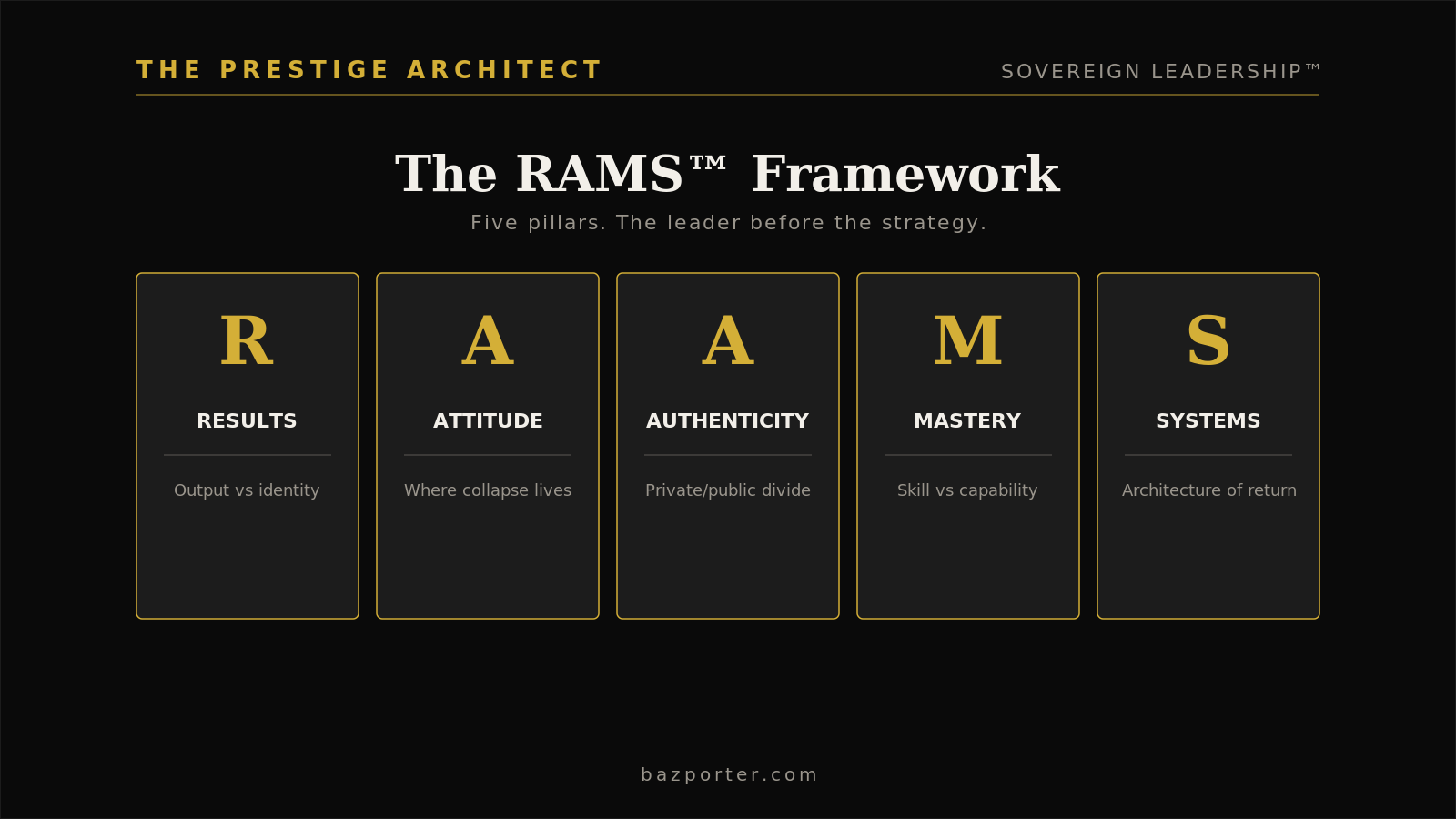
Results: The Output–Identity Gap
You measure the day by what got done. The calendar is the scoreboard. So an empty hour reads as a failure, and the work rushes in to fill it.
Collapsed pattern: Worth is computed from the day's output. Rest looks like loss.
Sovereign pattern: Worth is fixed. Recovery is a line item, not a reward.
Operational rule: Schedule the recovery first. Let the work fit around the center, not the other way round.
Attitude: Where the Collapse Lives
Attitude is the internal operating system. For the always-on leader, it runs one line of code: If I stop, it all falls apart. That belief keeps the loop open. It is not discipline. It is a survival reflex wearing a work ethic.
You are not behind on your calendar. You are running a life with no architecture — and a calendar cannot fix a structural problem.
Command decision: Name the reflex out loud. A belief you can see is a belief you can re-engineer.
Authenticity: The Private–Public Divide
In public, you are the leader with the relentless work ethic. In private, you are never fully anywhere. That gap is the engine of Silent Collapse™. The wider the divide, the louder the exhaustion.
Close the divide: Tell one person the truth — that present is the one place you never go.
Hold the divide: Keep performing devotion while the people at home get the leftovers.
Mastery: Skill Versus Sovereign Capability
You have mastered the schedule. That is skill. Sovereign capability is different. It is the capacity to be fully off — and fully whole — without the work running through you. Skill fills the calendar. Capability lets you leave it closed.
Systems: The Architecture of the Return
This is the pillar that engineers the return. A present life is built, not willed. You design the boundaries, the recovery, and the center into the structure — so being home does not depend on a good day.
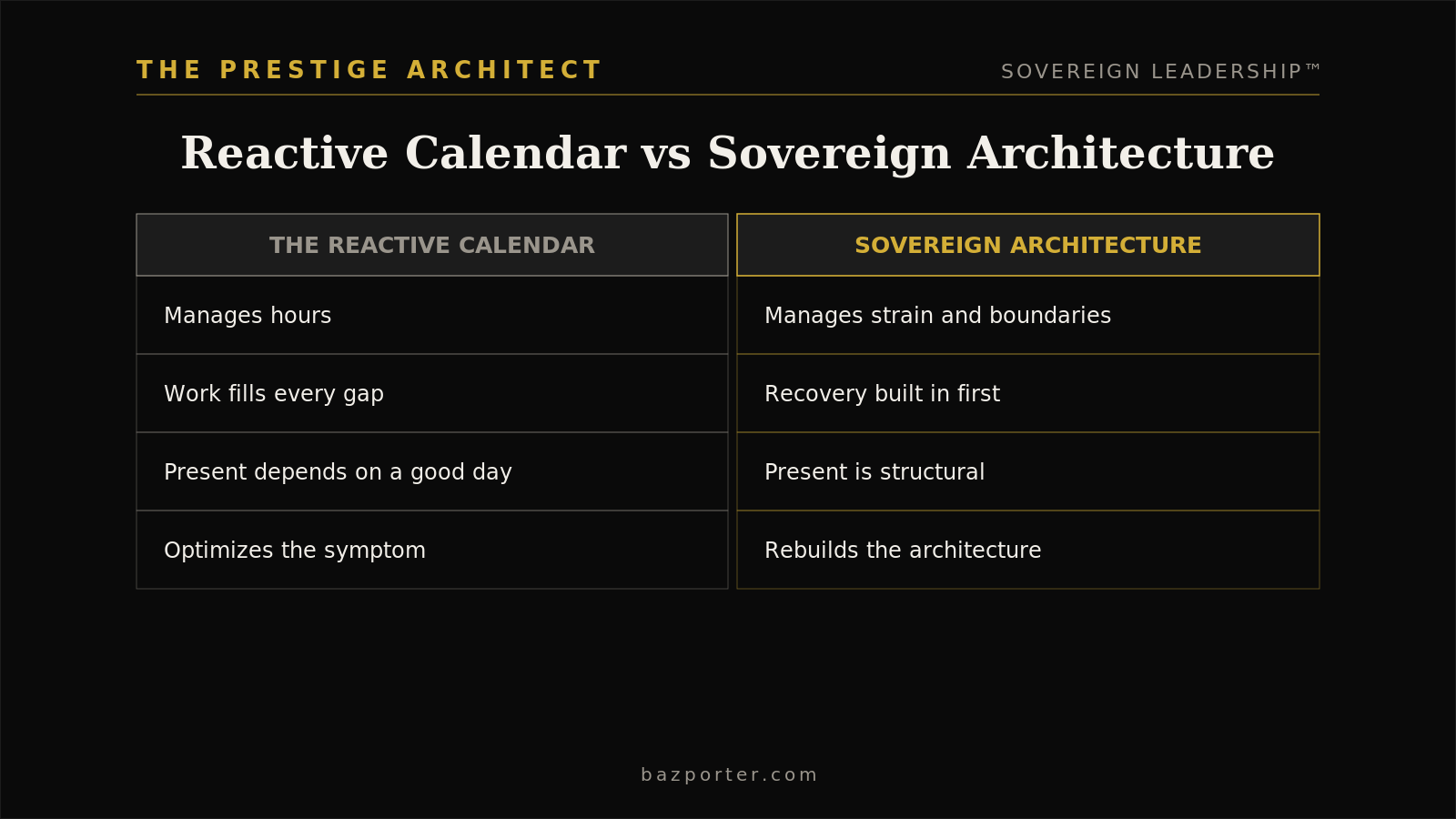
Most leaders are handed another scheduling tool. They need an architecture. Take the Silent Collapse Diagnostic to locate which pillar is carrying your collapse.
Case Vignette: The Color-Coded Calendar
One founder I worked with had the most disciplined calendar I had seen. Color-coded. Time-blocked. Reviewed every Sunday. He was also never home in the way that counts. The calendar was perfect; the architecture did not exist. We stopped tuning the schedule and built the structure. A hard close on the day. A recovery block protected like a board meeting. One center the week was built around. Within a month he was at the table — actually at the table. Systems first. The schedule followed.
The Architecture of Your Return
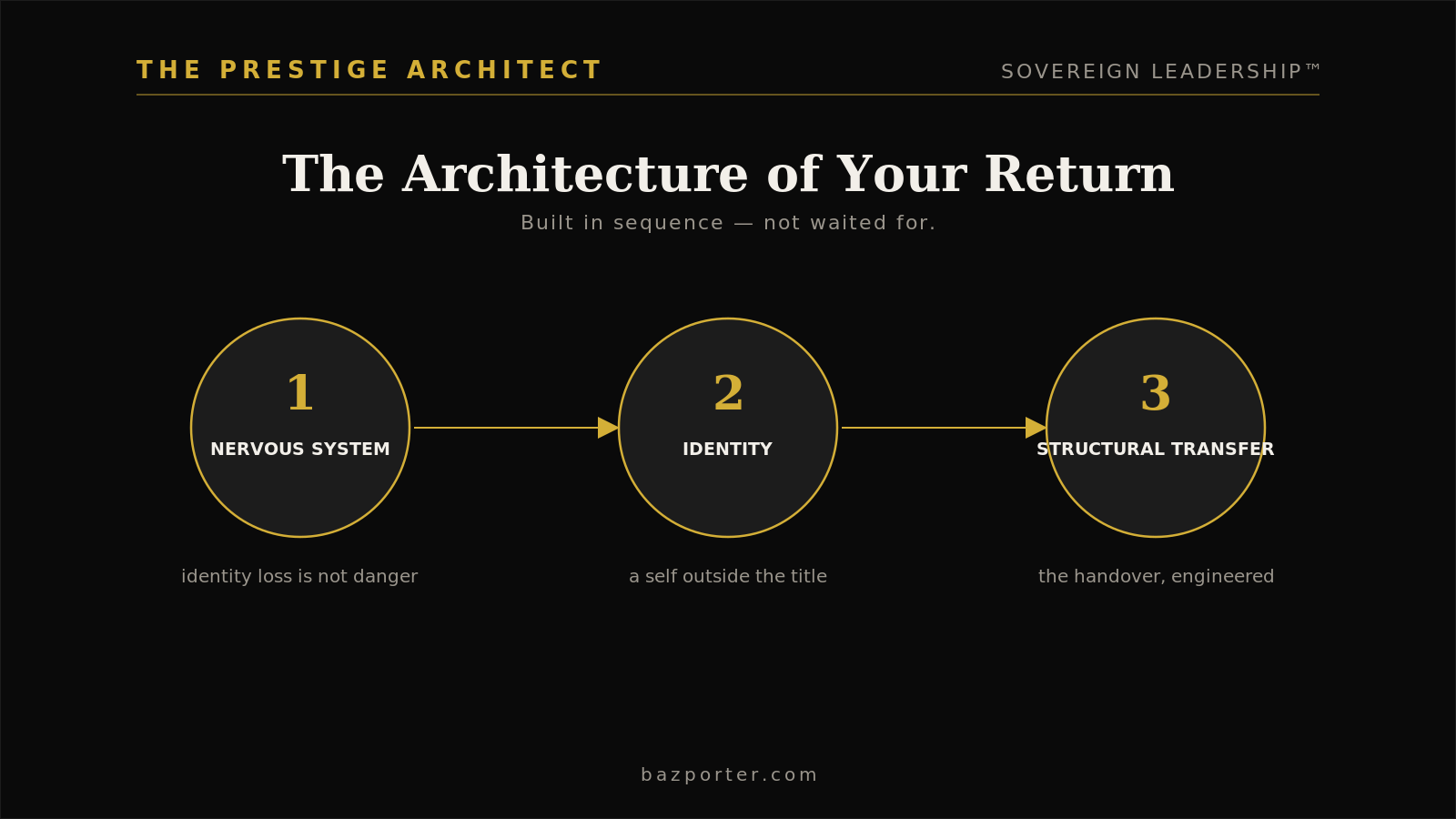
A present life is not a feeling you wait for. It is a structure you build. Nervous-system sovereignty comes first: the body learns that a closed loop is safe. Then the boundaries. Then the center the week is engineered around. Build it in that sequence and "always on" stops being your default. You become a leader who is fully at work and fully at home — because the architecture holds both.
You did not build the company by accident. You will not get your life back by accident either. The same engineering that scaled the work will build the leader who can leave it at the door. Apply to Work With Baz when you are ready to build the architecture of your return.
Frequently Asked Questions
Why does better time management never fix it for long?
Because time management treats a structural problem as a discipline problem. A calendar moves hours. It does not build boundaries, recovery, or a center. Without architecture, the work floods back every time. Build the structure and the schedule finally holds.
Is being always on really worse than just working long hours?
Yes. Cognitive strain, not raw hours, is now the leading driver of burnout (Harvard Business Review, 2026). The open loop — the mind that never closes the day — costs more than the hours themselves.
I am home but still not present. What is that?
That is an open loop, not a location problem. Your body arrived; your nervous system stayed at work. Presence is a structural outcome, not a willpower act. It returns when the day has a hard close built into the architecture.
How do I build a life I do not have to escape?
Engineer it through Systems, not willpower. Regulate the nervous system, set protected boundaries, then build the week around one center in that order. The result is designed, not survived.
About the Author
British military veteran. Two-time international bestselling author. Founder, The Prestige Architect®. Host, Rise From The Ashes podcast, C-Suite Network. Boulder, Colorado.