
For High-Achieving Women
Who Are Done Being Strangers to Themselves
You've built the empire. The multi-6-figure business. The corner office everyone envies.
But here's what nobody sees...
You're dying inside The 4 AM anxiety attacks. The calendar as armor.
The terrifying question that keeps you awake...
"If I stopped performing... would I disappear?"
Finally Choose Themselves Over Their To-Do Lists
Discover Why 97% of "Successful"
Women Are Secretly Collapsing Yours Free.


Dear Beautiful Soul,
I see you.
Not just your achievements or your carefully curated LinkedIn profile.
I see the woman behind the titles, beyond the metrics, beneath the mask of "having it all together."
I see you at 3AM, when the world is quiet but your mind isn't.
When the questions you can't ask in the boardroom become too loud to ignore.
"Why does achieving everything I wanted feel like losing myself?"
"When did success start feeling this heavy?"
I know this journey intimately.
Not because I'm another coach with strategies and systems (though yes, those matter).
But because I've walked alongside women who dared to question everything they built.
Like Lorraine, who found herself in the darkest place imaginable both personally and professionally.
Today, she's not just surviving; she's reaching heights she "didn't even realize she was looking for."
Her words, not mine:
"What Baz does is life altering. He reached my heart, my soul, and allowed me to come alive again."
Or Angela, who transformed her relationship with power entirely.
She stopped pushing through exhaustion and started leading from authentic presence.
Now her team doesn't just respect her they're inspired by her whole, unfiltered truth.
Then there's Sabrina, who discovered what happens when you stop trying to fit into old leadership models.
"Baz doesn't just offer advice," she shares, "he ignites a fire within. He empowers you to unlock unprecedented potential not just in yourself, but in your entire organization."
This isn't just about executive burnout or stress management.
Those are just symptoms of a deeper truth.
This is about reclaiming your soul in the midst of success.
About remembering who you were before the world told you who to be.
About leading from a place of power that doesn't require perfection.
I've watched women step into boardrooms not with rehearsed speeches, but with unshakeable presence.
I've seen them make million-dollar decisions from a place of inner knowing, not endless analysis.
I've witnessed them build global teams while staying deeply connected to themselves.
Your success got you here.
But your truth will take you further.
You don't need another strategy.
You need permission to lead differently.
To breathe differently.
To succeed differently.
To be differently.
The transformation you're seeking isn't about adding more to your already full plate.
It's about coming home to the woman you've always been beneath the achievements.
Ready to remember who you are beyond the titles?
With deep understanding and unwavering belief in your next chapter,
Baz
P.S. The fact that you're still reading means your soul knows something your schedule hasn't admitted yet.
It's time for real change.
Not the kind that looks good on paper, but the kind that feels true in your bones.

12 week Private Mentorship Program
Strategic Identity Reset
- 6 Private 90-Minute Sessions with Baz Porter
- Comprehensive Identity & Authenticity Assessment
- Success Wound Identification & Healing Protocols
- Authentic Leadership Development Protocols
- 4-Week Post-Program Integration Period
- Custom Identity Reclamation Resources
- Stop waking up at 4 AM wondering if you matter beyond what you produce
- End the exhausting performance that's killing your soul while keeping your success
- Make decisions from your authentic self, not from fear of disappointing others
- Lead without the armor and watch people finally connect with the real you
- Create legacy impact that feeds your soul, not just your bank account
Million Dreams Community
Where High-Achieving Women Transform Together
- Weekly hot seat calls with direct solutions
- Immediate executive strategy planning
- Elite peer accountability
- Direct access to proven frameworks
- Reclaim 10+ hours weekly
- Transform your energy in 30 days
- Build unshakeable leadership presence
- Create impact without exhaustion


Hi I'm Baz...

I know what it's like to look successful on the outside while falling apart on the inside.
My journey from British military veteran to rock bottom taught me the hardest truth, sometimes you have to lose everything to find yourself.
After my own dark night of the soul battling depression, facing homelessness, and questioning everything I discovered something powerful.
Real transformation isn't about pushing harder. It's about coming home to yourself.
Today, I guide high-achieving women from exhaustion to embodied leadership. Featured in Yahoo, CEO Weekly, Women Leaders Magazine, and Digital Journal, my work goes beyond traditional coaching.
Not because I have all the answers, but because I understand the questions that keep you up at 3AM.
This isn't about adding more strategies to your life. It's about remembering who you were before the world told you who to be.
Ready to come home to yourself?
TAKE YOUR FIRST STEP
Begin With Your Private Reset Ritual
Join hundreds of female executives who started their transformation here.
No pressure. No performance. Just presence.
(Start sleeping better in 5 days or less)
What is Inclusive Leadership: A Guide to Unlocking Resilient Teams
Your team is hitting every target, but something is off.
There’s a subtle friction you can’t name. A quiet disengagement that never shows up on quarterly reports. You can feel the growing chasm between the incredible results you’re driving and the actual energy in the room. This is the silent collapse so many high-achieving leaders experience. The very drive for excellence, when unchecked, accidentally breeds a culture of conformity and fear.
Key Takeaways
The Neuroscience of Belonging: Inclusive leadership isn't a soft skill; it's a neurological trigger. It shifts your team's brains from a primal "threat state" (self-preservation) to an expansive "reward state," unlocking creativity and collaboration.
The Six Signature Traits: True inclusion is built on six learnable behaviors: Commitment, Courage, Cognizance of Bias, Curiosity, Cultural Intelligence, and Collaboration. These are actionable skills, not personality types.
The Competitive Advantage: Inclusive leadership is a hardcore business strategy. It directly leads to better decisions, faster problem-solving, and a proven ability to capture new markets—with inclusive companies being 70% more likely to do so.
Avoiding the Traps: The biggest pitfalls are performative allyship (symbols without action), confusing diversity metrics with true inclusion (hiring vs. retaining), and becoming defensive to feedback. Impact always outweighs intent.
The Disconnect in High-Performance Teams
You’ve engineered a machine primed for success, but you’re starting to wonder about the human cost. That internal monologue sounds painfully familiar: “If I push them any harder, will the whole thing break? Why isn’t anyone challenging my ideas anymore?”
This is the hidden pattern where performance metrics completely overshadow psychological safety. It creates invisible fractures that threaten your team’s long-term resilience. The same intensity that fuels your success is now quietly suffocating the trust and innovation you need to sustain it.
Inclusive leadership is a strategic framework for creating an environment where every single person feels valued, respected, and psychologically safe enough to bring their whole, unfiltered perspective to the table. It's about intentionally building a culture where unique differences are seen as a competitive advantage, not a problem to be managed.
To move past this, leaders are starting to rethink their approach, often turning to more effective executive team building activities designed to rebuild genuine connection from the ground up.
Understanding Inclusive Leadership at Its Core
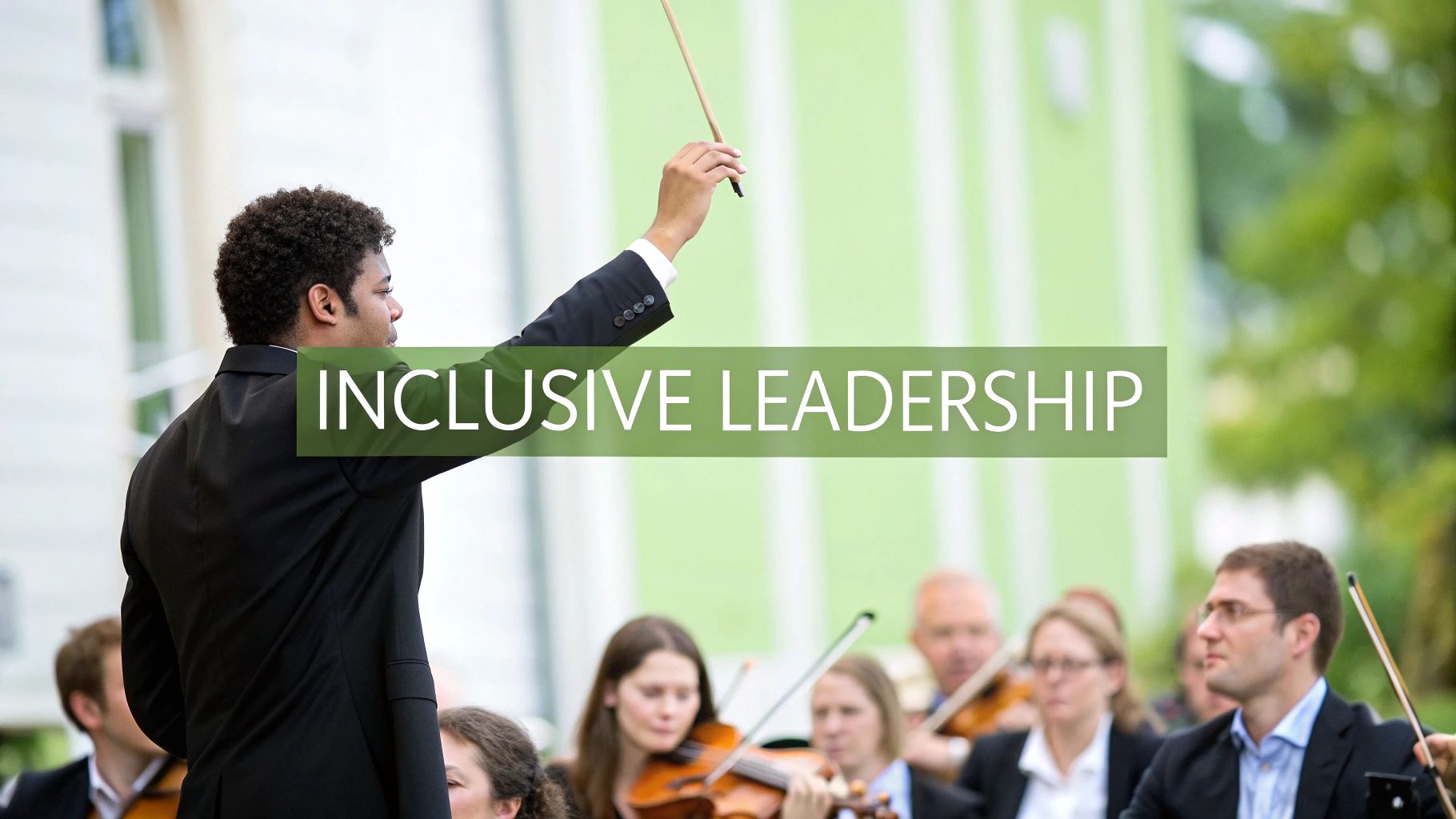
Think of yourself as an orchestra conductor. Your power doesn't come from playing every instrument. It comes from masterfully harmonizing the distinct sounds of the strings, brass, and percussion. You create the exact conditions for each musician to perform at their absolute best, knowing the resulting symphony will be infinitely richer than anything a single instrument could produce. That’s the inclusive leader—orchestrating diverse talents to create something truly extraordinary.
The Neuroscience of Belonging
This approach isn’t just good management; it’s neuroscience. When people feel a genuine sense of belonging, their brains literally shift gears. They move out of a primal "threat state" (fight, flight, freeze) and into a more expansive "reward state." That neurological shift is everything.
A brain in a threat state is closed off, focused only on self-preservation. But a brain in a reward state is flooded with neurotransmitters like dopamine and oxytocin, which unlock higher cognitive functions. For your team, this means they suddenly have access to:
Enhanced Creativity: People become willing to share wild ideas without the paralyzing fear of being shot down.
Improved Problem-Solving: A wider range of perspectives converges on a single challenge, leading to more robust solutions.
Deeper Collaboration: Trust pushes suspicion aside, making way for genuine teamwork and shared ownership.
But when you just hit targets without building this inclusive foundation, you create a slow-burn problem. The team dynamic starts to break down under the surface.
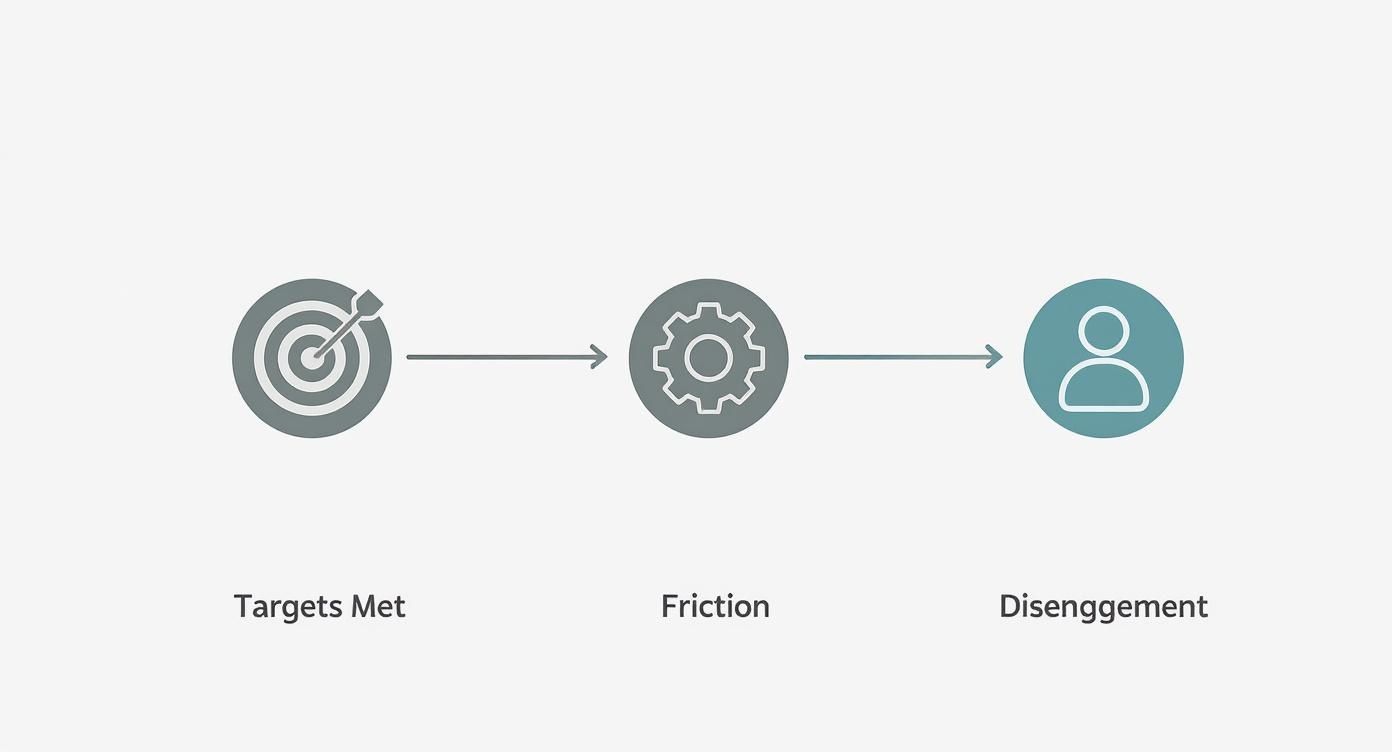
This flowchart shows how initial success can mask the friction that eventually leads to a completely disengaged and fractured team.
The Measurable Impact on Performance
This isn't theory, the data is overwhelming. Research consistently shows that an inclusive environment is a high-performing environment. A Gallup study found that business units with high employee engagement (a direct outcome of inclusion) see a 23% difference in profitability.
At its heart, inclusive leadership is about creating a workplace where diversity truly thrives because inclusion is the default setting. Understanding the powerful effects of leadership-driven diversity and inclusion is the key to unlocking stronger, more resilient teams. This style has a direct, measurable impact on both your people and your profits. While it shares some DNA with other leadership models, it's a distinct discipline; you can explore those differences in our guide on what is authentic leadership.
The Six Signature Traits of an Inclusive Leader
Talking about inclusive leadership is one thing; putting it into practice day after day is another entirely. This isn't some vague personality type you're born with. It's a set of observable, learnable skills that anyone can cultivate. Based on deep research from Deloitte, six signature traits emerge as the essential blueprint for action.
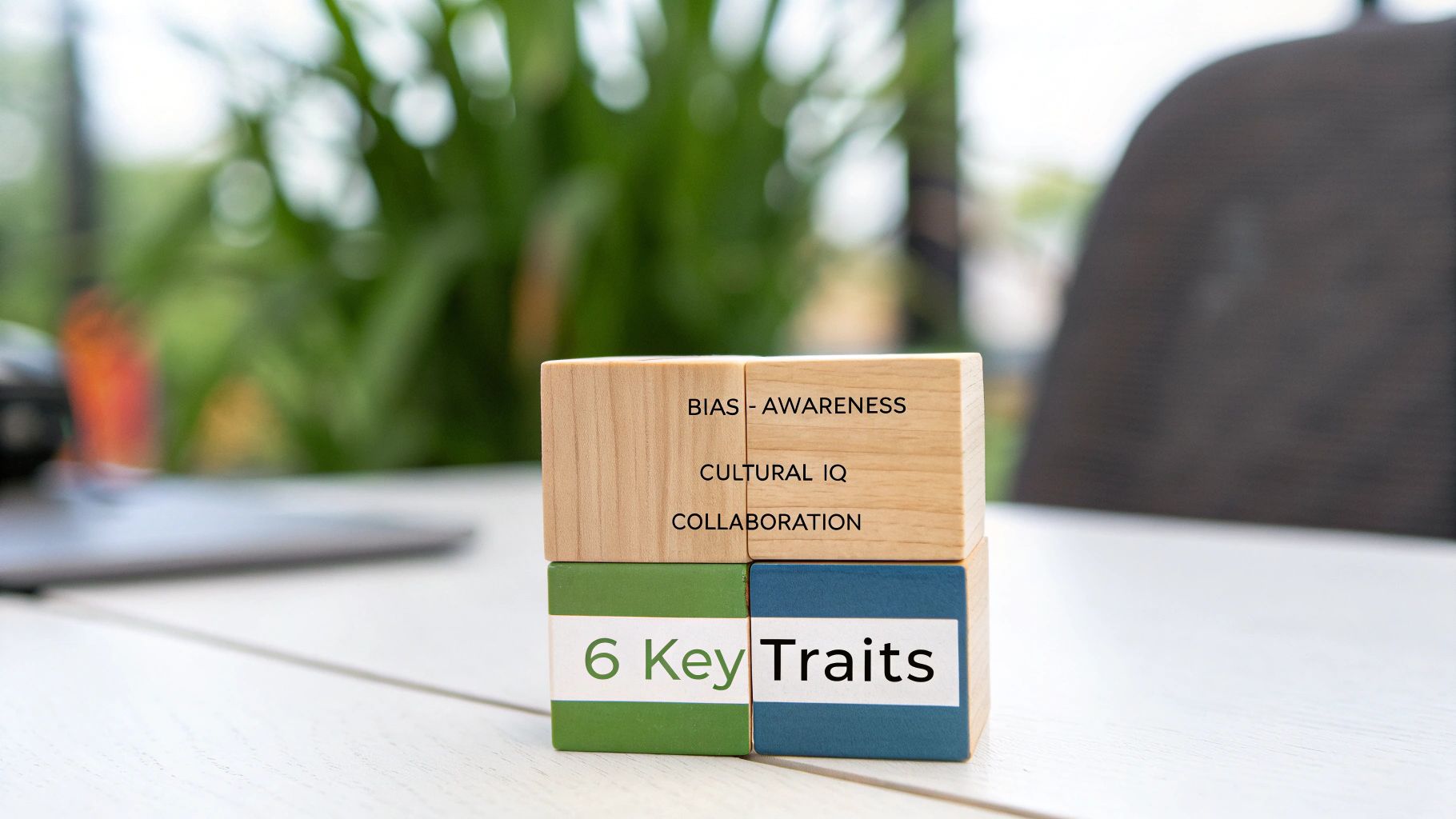
Don't think of these traits as a checklist for perfection. They're about consistent, intentional practice.
Commitment and Courage
It all starts here. The bedrock of inclusive leadership is an unwavering Commitment. This isn't about slapping a diversity statement on your website. It's about allocating real resources, your time, budget, and personal energy. It means holding yourself accountable for building a culture where everyone belongs.
Hand-in-hand with commitment comes Courage. This is the quiet strength to challenge the status quo, to speak up against microaggressions, and to protect the psychological safety of your people. It’s pulling someone aside to address a biased comment. It’s defending a team member's unconventional idea. When your actions consistently align with what professional values are, you build trust.
Cognizance of Bias and Curiosity
Every single one of us has unconscious biases. Our brains are wired for shortcuts. An inclusive leader has a sharp Cognizance of Bias—the humility to admit they have blind spots and the discipline to actively work against them. This means intentionally slowing down big decisions to consciously question your gut feelings.
One of the most powerful things you can do is simply ask, "Whose perspective is missing from this conversation?" before finalizing a plan. That one question can shatter confirmation bias and open the door to far richer insights.
This self-awareness naturally fuels Curiosity. Inclusive leaders operate from a place of genuine inquiry, not assumption. They ask open-ended questions and actually listen to the answers instead of just waiting for their turn to talk. They actively seek out perspectives that challenge their own.
Cultural Intelligence and Collaboration
Next is Cultural Intelligence (CQ), the ability to work effectively across different cultural contexts. This goes deeper than knowing different holidays. It’s about adapting your communication style and understanding how your words and actions might land with someone from a different background.
Ultimately, all these other traits come together in Collaboration. Inclusive leaders are masters at empowering their teams. They build environments where power is shared, credit is given freely, and everyone feels a real sense of ownership. They don't just assemble diverse teams; they foster the conditions where those diverse minds can mesh, challenge each other, and co-create brilliant solutions.
Why Inclusive Leadership Is a Competitive Advantage
Let's be clear: inclusive leadership is not a feel-good initiative or a box-ticking exercise. It's a hardcore, data-backed strategy for building a resilient, high-performing organization that dominates its market.
When leaders intentionally build an inclusive culture, they are sharpening their company’s competitive edge. This isn't a ‘soft skill’—it’s a fundamental driver of superior business results.
Organizations that get this right see a powerful return. A Boston Consulting Group study found that companies with more diverse management teams report 19% higher revenues due to innovation. Why? Because you’re finally unleashing the full spectrum of thinking on your team.
Instead of the dangerous echo chamber of groupthink, you get a dynamic collision of ideas that sparks genuine breakthroughs. This diversity of thought is exactly what you need to solve complex problems.
From Better Decisions to Market Capture
The benefits cascade across the entire organization. Inclusive teams simply make better, faster decisions with less risk.
When people feel safe enough to dissent and challenge assumptions, the collective intelligence of the group skyrockets. You sidestep the catastrophic blind spots that homogenous teams don’t even know they have.
The impact on growth is undeniable. Research shows that inclusive companies are 70 percent more likely to capture new markets. A team that reflects the diversity of your customer base can anticipate needs and spot opportunities that others miss. They bring an innate understanding of different user experiences, which translates directly into better products.
A compelling case study from Wall Street highlights this perfectly. A research department, once ranked 15th, hired more women analysts and empowered them to work authentically. These women tapped into informal investor networks their male colleagues had overlooked. Within three years, the firm’s ranking shot up to first place.
The War for Talent and Engagement
In the relentless war for talent, inclusive leadership is your most potent weapon. High-performers, especially from underrepresented groups, are actively seeking environments where they can show up as themselves.
By creating a true culture of belonging, you not only attract top-tier talent but also dramatically improve retention. You stop the revolving door.
Engaged employees are productive employees. Period. When people feel seen and respected, their discretionary effort—that willingness to go the extra mile—soars. This creates a virtuous cycle of innovation, high performance, and sustainable success that your competitors simply cannot replicate.
Embedding Inclusive Practices in Your Organization
Moving from individual habits to organizational systems is where the real work of inclusive leadership truly begins. Lasting change doesn’t just happen; you have to engineer it into the fabric of how your company operates.
It’s about designing systems where inclusive behaviors are the default, not the exception. This takes a hard look at your daily rhythms. How do you run meetings? What’s the real criteria behind performance reviews? Who gets tapped for high-profile projects? Each of these moments is a chance to either reinforce old biases or intentionally build a more equitable structure.

From Hiring to Meeting Culture
The process starts at the front door: your hiring and onboarding. An inclusive approach means standardizing interview questions, pulling together diverse hiring panels, and scrubbing job descriptions of biased language. Once someone is on board, mentorship and sponsorship programs are critical for giving everyone an equitable shot at success.
Your meeting culture is another huge lever. Inclusive meetings need clear agendas, rules for participation, and a facilitator who actively pulls in quieter voices. It's a system built to stop the loudest person from dominating. To foster this kind of empowerment, it helps to understand the principles of leadership and delegation.
Accountability and Strategic Integration
Ultimately, none of this works without clear accountability. This isn’t just about good intentions; it's about measurable outcomes.
Inclusive leadership must be woven into performance management. Leaders should be evaluated and rewarded based on their ability to foster psychological safety, develop diverse talent, and build collaborative teams. When inclusion becomes a core competency for advancement, the entire culture begins to shift.
This strategic pivot is catching on. A recent executive survey revealed that while only 33% of organizations currently have a senior leader dedicated to inclusion, over 50% of executives plan to maintain or increase their investment. This shows a clear shift toward an integrated approach tied directly to strategy. You can dig into more of these findings in DHR Global's executive leadership report.
Building these systems can feel like a massive undertaking, which is why many executives find real value in dedicated programs. For a guide on structuring these initiatives, check out our article on transforming organizational culture through corporate leadership events. These systemic changes are what turn a leader's personal commitment into a lasting organizational advantage.
Common Pitfalls in Inclusive Leadership and How to Avoid Them
Knowing what inclusive leadership is and practicing it under pressure are two very different things. Even leaders with the best intentions stumble into traps that erode trust.
Seeing these pitfalls for what they are is the first step. These aren't failures of character; they're failures of strategy. The path to real inclusion is paved with self-awareness and a commitment to learning from missteps.
Performative Allyship vs. Authentic Action
One of the most visible traps is performative allyship. This is showing symbolic support for marginalized groups without taking concrete action to dismantle the systems that hold them back.
It’s posting a black square on Instagram while ignoring internal pay gaps. It’s loud, it’s public, and it’s hollow.
To avoid this, your actions must have weight.
Move Beyond Symbols: Instead of just making public statements, change internal policies.
Use Your Power: Don't just mentor, actively sponsor people from underrepresented groups. Put their name forward in rooms they can't access.
Ask, Don't Assume: Stop guessing what support people need. Ask your marginalized colleagues directly what would be helpful.
Authentic action is often quiet and consistent. It’s focused on systemic change, not public applause.
Confusing Diversity Metrics with True Inclusion
Another massive pitfall is mistaking diversity numbers for genuine inclusion. Hitting a hiring quota is meaningless if those new hires walk into a culture where they don't feel psychologically safe, respected, or heard.
If your turnover rates for diverse talent are high, you don’t have an inclusive culture. You have a revolving door.
The real measure of inclusion isn’t who you hire; it’s who you retain, develop, and promote. It's about who feels empowered to speak up in a high-stakes meeting.
To get out of this trap, pair your quantitative data with qualitative insights. Start conducting "stay interviews" to find out why people are sticking around and what would make their experience even better.
Becoming Defensive to Feedback
This is perhaps the toughest hurdle: learning to take critical feedback without getting defensive. When someone points out a blind spot or a microaggression, our first instinct is often to defend our good intentions.
But in this work, impact always outweighs intent.
Becoming defensive instantly shuts down the conversation. It sends a clear signal that it’s not safe to be honest with you.
To build this muscle, practice pausing before you respond. Thank the person for their courage, and then approach their feedback with genuine curiosity, not judgment. This is a non-negotiable skill for any leader and is a core focus in dedicated leadership training for women who are often expected to manage these situations with exceptional grace.
Your Questions, Answered: The Messy Truth About Inclusive Leadership
Putting inclusive leadership into practice is where things get real. It’s one thing to read the theory; it’s another to navigate the tricky, real-world questions that pop up in a tense project discussion.
Getting clear on these nuances separates leaders who mean well from those who make a meaningful impact. Let’s tackle the most common questions from executives doing this work on the ground.
How Do I Actually Know If This Is Working?
Measuring the impact of your leadership isn’t about one magic number. It’s about weaving together hard data with human stories.
First, look at the quantitative evidence, the numbers you can track over time:
Who Stays? Look at your talent retention rates, but slice the data. Are you keeping the diverse people you fought so hard to hire?
Who Rises? Analyze promotion velocity. How quickly do people from different backgrounds move up? The data shows where the real blockages are.
How Do They Really Feel? Use targeted engagement surveys that ask specifically about psychological safety and a sense of belonging. Get a real pulse on your team's sentiment.
Then, layer on the qualitative side to understand the why behind those numbers:
Conduct "Stay" Interviews. Stop waiting for exit interviews. Sit down with your best people and ask them why they stay.
Embrace 360-Degree Feedback. Gather structured, anonymous feedback to see yourself as your team sees you. It’s not comfortable, but it’s always clarifying.
Watch the Room. In your next meeting, who speaks up without hesitation? Who gets interrupted? The proof is when more people feel empowered to contribute.
Isn't This Really Just for Diverse Teams?
Absolutely not. While the benefits are supercharged in a diverse team, its core principles unlock the potential of any team. It’s about optimizing the talent you already have.
Even in a team that looks homogenous, you have huge cognitive diversity. You have different thinkers, problem-solvers, introverts, and visionaries.
An inclusive leader in that environment actively fights against groupthink. They make it safe for someone to be the lone voice of dissent or propose a wild idea. That’s not a “nice-to-have”—it’s the foundation of innovation.
What’s the Single Most Important Thing I Can Do Today?
If you do only one thing, make it this: in your very next conversation, shift your entire focus from directing to inquiring. Get fiercely curious.
This isn’t about waiting for your turn to talk. It's about practicing deep, active listening. Listen with the sole intent to understand, not to formulate your response.
Try asking one of these questions:
"Tell me more about how you're seeing this."
"What's a perspective we haven't considered yet?"
"What might be the risk if we go down this path?"
In your next meeting, consciously notice who hasn’t spoken. Then, create an opening for them. A simple, "Sarah, I'd love to get your thoughts on this," can change the entire dynamic. This tiny behavioral shift sends a massive signal: your voice matters here. It’s the first, most powerful step toward returning to yourself as a leader.
At Baz Porter, we help leaders move beyond the burnout of traditional models. If you're ready to build a style that is both powerful and sustainable, one that reclaims your nervous-system sovereignty, it's time to explore a new way forward.

Voted number #1 for Leadership by the Best of the Best 2024. Real growth for High performing women who love life & demand more.
⭐⭐⭐⭐⭐
1630 30th Street Ste A - 418
Boulder Colorado 80301
United States
Phone: +1-646-212-4807
CUSTOMER CARE
NEWS
LEGAL


© 2019 - 2025 | Baz Porter LLC. All rights reserved.
Protected by all the possible laws. If you wanna try and copy it. We are gonna come after you. Liam Neeson Style.
Terms Of Use | Privacy Policy | Disclaimer