
For High-Achieving Women
Who Are Done Being Strangers to Themselves
You've built the empire. The multi-6-figure business. The corner office everyone envies.
But here's what nobody sees...
You're dying inside The 4 AM anxiety attacks. The calendar as armor.
The terrifying question that keeps you awake...
"If I stopped performing... would I disappear?"
Finally Choose Themselves Over Their To-Do Lists
Discover Why 97% of "Successful"
Women Are Secretly Collapsing Yours Free.


Dear Beautiful Soul,
I see you.
Not just your achievements or your carefully curated LinkedIn profile.
I see the woman behind the titles, beyond the metrics, beneath the mask of "having it all together."
I see you at 3AM, when the world is quiet but your mind isn't.
When the questions you can't ask in the boardroom become too loud to ignore.
"Why does achieving everything I wanted feel like losing myself?"
"When did success start feeling this heavy?"
I know this journey intimately.
Not because I'm another coach with strategies and systems (though yes, those matter).
But because I've walked alongside women who dared to question everything they built.
Like Lorraine, who found herself in the darkest place imaginable both personally and professionally.
Today, she's not just surviving; she's reaching heights she "didn't even realize she was looking for."
Her words, not mine:
"What Baz does is life altering. He reached my heart, my soul, and allowed me to come alive again."
Or Angela, who transformed her relationship with power entirely.
She stopped pushing through exhaustion and started leading from authentic presence.
Now her team doesn't just respect her they're inspired by her whole, unfiltered truth.
Then there's Sabrina, who discovered what happens when you stop trying to fit into old leadership models.
"Baz doesn't just offer advice," she shares, "he ignites a fire within. He empowers you to unlock unprecedented potential not just in yourself, but in your entire organization."
This isn't just about executive burnout or stress management.
Those are just symptoms of a deeper truth.
This is about reclaiming your soul in the midst of success.
About remembering who you were before the world told you who to be.
About leading from a place of power that doesn't require perfection.
I've watched women step into boardrooms not with rehearsed speeches, but with unshakeable presence.
I've seen them make million-dollar decisions from a place of inner knowing, not endless analysis.
I've witnessed them build global teams while staying deeply connected to themselves.
Your success got you here.
But your truth will take you further.
You don't need another strategy.
You need permission to lead differently.
To breathe differently.
To succeed differently.
To be differently.
The transformation you're seeking isn't about adding more to your already full plate.
It's about coming home to the woman you've always been beneath the achievements.
Ready to remember who you are beyond the titles?
With deep understanding and unwavering belief in your next chapter,
Baz
P.S. The fact that you're still reading means your soul knows something your schedule hasn't admitted yet.
It's time for real change.
Not the kind that looks good on paper, but the kind that feels true in your bones.

12 week Private Mentorship Program
Strategic Identity Reset
- 6 Private 90-Minute Sessions with Baz Porter
- Comprehensive Identity & Authenticity Assessment
- Success Wound Identification & Healing Protocols
- Authentic Leadership Development Protocols
- 4-Week Post-Program Integration Period
- Custom Identity Reclamation Resources
- Stop waking up at 4 AM wondering if you matter beyond what you produce
- End the exhausting performance that's killing your soul while keeping your success
- Make decisions from your authentic self, not from fear of disappointing others
- Lead without the armor and watch people finally connect with the real you
- Create legacy impact that feeds your soul, not just your bank account
Million Dreams Community
Where High-Achieving Women Transform Together
- Weekly hot seat calls with direct solutions
- Immediate executive strategy planning
- Elite peer accountability
- Direct access to proven frameworks
- Reclaim 10+ hours weekly
- Transform your energy in 30 days
- Build unshakeable leadership presence
- Create impact without exhaustion


Hi I'm Baz...

I know what it's like to look successful on the outside while falling apart on the inside.
My journey from British military veteran to rock bottom taught me the hardest truth, sometimes you have to lose everything to find yourself.
After my own dark night of the soul battling depression, facing homelessness, and questioning everything I discovered something powerful.
Real transformation isn't about pushing harder. It's about coming home to yourself.
Today, I guide high-achieving women from exhaustion to embodied leadership. Featured in Yahoo, CEO Weekly, Women Leaders Magazine, and Digital Journal, my work goes beyond traditional coaching.
Not because I have all the answers, but because I understand the questions that keep you up at 3AM.
This isn't about adding more strategies to your life. It's about remembering who you were before the world told you who to be.
Ready to come home to yourself?
TAKE YOUR FIRST STEP
Begin With Your Private Reset Ritual
Join hundreds of female executives who started their transformation here.
No pressure. No performance. Just presence.
(Start sleeping better in 5 days or less)

The High Achiever's Dilemma: Negotiating Salary With Promotion
You got the promotion. (Yay)
The email lands, the call ends, and a wave of adrenaline washes over you.
Recognition. The new title. The hard-won validation. It's exhilarating.
But then, as the high subsides, a quieter, colder thought creeps in.
“What about the money?”

This flicker of anxiety is your nervous system flagging a critical moment. That initial rush gives way to a familiar fear for so many high-achievers: the dread of being undervalued at the precise moment you’ve proven your worth.
This is the Silent Collapse.
The internal moment where the excitement of a win gets crushed by the pressure to secure compensation that truly reflects it. It’s the gap betweenknowingyour value and finding the somatic courage to voice it.
The internal monologue is deafening. “Am I being too demanding?” “Shouldn’t I just be grateful?” It’s a pattern tangled with deeper anxieties, like the persistent fear that if you stop performing, you'll disappear. For many, this is a symptom of a larger struggle, and you can explore our insights on overcoming imposter syndrome for women executives to see how deep these patterns run.
This guide is not about generic tips. It is a playbook to interrupt that cycle. We will shift you from reactive anxiety to proactive, grounded leadership, building an undeniable case for your worth one rooted not in emotion, but in data, impact, and the powerful RAMS™ framework By Baz Porter.
This is about stepping fully into the authority of your new role, backed by compensation that honors the leader you have become.
Why Salary Negotiation Is Your Promotion's Final Test
That promotion isn’t just a reward for past work. It's a strategic bet the company is making on its future with you in a bigger role. The salary conversation isn't an awkward chore. It's the final, unspoken part of your promotion interview.
The company just handed you this role because they believe you can lead, drive results, and make smart business decisions. How you navigate this talk is their first real-time test of those exact skills in your new capacity.
This is where you demonstrate the executive presence you were just promoted for. Simply accepting the first offer can, from a leadership perspective, signal hesitation or a shaky belief in your own elevated worth.
The Unspoken Expectation from Leadership
Many leaders and HR professionals don't just anticipate negotiation from top talent they expect it. An initial offer is almost always a starting point, a number that fits a budget but has room built in.
When you prepare to negotiate, you are not being difficult. You are acting like a business leader. You are showing that you understand market value, the company's economics, and your own contribution to the bottom line.
This conversation is your first act of leadership in the new role. It sets the precedent for how you value your contributions and, by extension, how you will advocate for your team.
Companies are not looking for employees who passively accept what's handed to them. They seek partners who push for better outcomes. Your salary negotiation is a small-scale demonstration of that big-picture capability.
Navigating the Reality of Budgets
Of course, you must approach this with strategic empathy. Companies run on tight financial frameworks.
Take global salary increase budgets. The latest World at Work Salary Budget Survey shows U.S. organizations are projecting an average salary increase budget of 3.8%for the upcoming year.
This isn't to discourage you; it's a strategic insight. It means your argument has to be exceptionally well-reasoned. You’re competing for limited funds, so your case must be built on undeniable proof of the added value you'll bring, justifying an investment beyond the standard bump.
From Gratitude to Grounded Assertiveness
One of the biggest internal hurdles for high-achieving women is the feeling that asking for more seems ungrateful. The thought, "They picked me, I should just be happy," is a conditioned response, not a leadership strategy.
Real leadership is holding two ideas at once: deep gratitude for the opportunity and an unwavering belief in your worth. They are not mutually exclusive.
See this negotiation not as a conflict, but as a collaboration. You and your employer are aligning your compensation with a new level of responsibility.
You are not asking for a favor. You are aligning pay with a new scope of work.
You are not being demanding. You are presenting a business case.
You are not risking the offer. You are confirming you're ready for executive-level conversations.
By engaging in this discussion, you are doing more than just securing a better salary. You are cementing your position as a leader, fully stepping into the authority of your new role from day one.
Building Your Unshakeable Negotiation Case
The real negotiation begins with the quiet, focused work you do beforehand. This preparation is your anchor. It's what turns nervous energy into grounded, confident authority.
Building your case isn't about aggression. It is about laying out meticulous, undeniable logic.
Anxiety loves a vacuum. The single best way to calm a racing mind is to fill that empty space with cold, hard data and a clear story of your value. This is how you shift from feeling like you’re asking for something to demonstrating what you’ve already earned.
Quantify Your Past to Justify Your Future
Your track record is the bedrock of your negotiation. Vague statements won't land. You must translate your contributions into the language the business understands: numbers, percentages, dollars.
Do a deep dive into your accomplishments. Dig through old performance reviews and project reports. Don't just list what you did; quantify theoutcome.
Did you lead a project that increased team efficiency? By what percentage?
Did you roll out a new process that saved money? How much?
Did you mentor a junior who then crushed their sales targets? By what margin?
These are not just metrics; they are proof. They show you’re not just a reliable employee, but a strategic asset who generates a tangible return. This process is also a powerful antidote to feeling "never enough," a struggle explored in our guide on overcoming the hidden cost of success for high-achieving women.
Arm Yourself with Market Data
Walking into this conversation without market data is like navigating without a map. You have no objective frame of reference. Your personal feelings about what you "deserve" are valid, but data makes your case impersonal and irrefutable.
Lean on credible, unbiased sources.
Payscale: Detailed salary reports based on role, experience, and location.
Salary.com: Robust data showing the full compensation range for a position.
Glassdoor: Real-world salary data for specific companies.
Levels.fyi: Essential for the tech industry, offering detailed compensation breakdowns.
Your goal is to establish a credible salary band for your new role, in your city, for your industry. This research does more than give you a number it gives you the unshakeable confidence to state your target salary without flinching.
When you can say, "Based on my research for a Director of Marketing in the SaaS space in Austin, the typical compensation range is between $X and $Y," you are no longer sharing an opinion. You are stating a business fact.
Define Your Three Numbers
With your market data, it’s time to set your personal negotiation parameters. This framework brings clarity and helps you stay centered. You need three specific figures locked in your mind.
Your Ideal Number:Your ambitious-but-realistic target at the top of your researched range. This is your anchor.
Your Satisfactory Number:The number you’d be genuinely happy with. It feels solid and fair.
Your Walk-Away Number:Your non-negotiable floor. Knowing this number is a profound act of self-respect.
Defining these numbers strips the emotional guesswork out of the live negotiation. It gives you a clear decision-making framework, empowering you to respond strategically.
Create Your Value Articulation Framework
The final piece of preparation is connecting the dots. Explicitly link your past achievements to the future requirements of this new role. This is how you show you are not just qualified you are the single best investment.
A simple framework can structure this narrative powerfully.
Use this structure to map your past achievements to your new responsibilities, helping you articulate your value proposition clearly and confidently.

This framework is your script. It is the logical, data-driven story that proves your worth beyond doubt.
With this preparation, you are no longer just an employee asking for a raise. You are a strategic partner presenting a compelling business case.
Mastering the Negotiation Conversation
You’ve done the prep work. Your case is airtight. Now comes the moment it all comes together: the conversation.
Think of this not as a confrontation, but as a collaborative alignment. The energy you bring into this meeting is as critical as your words.
Ground yourself. This conversation is your first act of leadership in this new capacity. You are not asking for a favor. You are clarifying the terms of a business investment the company's investment in you.
Opening the Dialogue and Responding to the First Offer
The moment they present the first number is pivotal. Your nervous system will likely jolt, screaming for an immediate reaction. Your job is to simply pause.
Breathe. Create space.
An instant "yes" almost always leaves money on the table. A reactive "no" can shut down the conversation. Instead, lead with appreciation and curiosity.
Example Script:
“Thank you so much for sharing that with me. I’m incredibly excited about stepping into this new role. To make sure we're fully aligned, I’d like to discuss the compensation package in more detail.”
This phrase buys you time, acknowledges their offer gracefully, and clearly states your intention to negotiate. It keeps the energy positive and frames you as a thoughtful, strategic partner.
Making Your Counter-Proposal with Grounded Confidence
When you present your counter-offer, anchor it directly to your research. This isn't about what youwant; it’s a logical business case based on what the market dictates.
Use clear, unapologetic language. Strike phrases like "I was hoping for..." or "I feel like..." from your vocabulary. They undermine your authority.
The Script: “Based on my research of the market for this role’s scope and the value I’ll be bringing, I’m targeting a base salary of [$Your Ideal Number]. I’m confident we can find a number that reflects both the opportunity and the impact I’m ready to deliver.”
The formula is: Market + Scope + Value = Your Target. It’s simple, powerful, and proves you’ve done your homework.
And then comes the hardest part. Once you state your number, stop talking. Let the silence hang. This can be uncomfortable, often triggering the fear of being disliked, but it is a non-negotiable part of demonstrating executive presence.
The infographic below breaks down the pillars that support a powerful negotiation case.
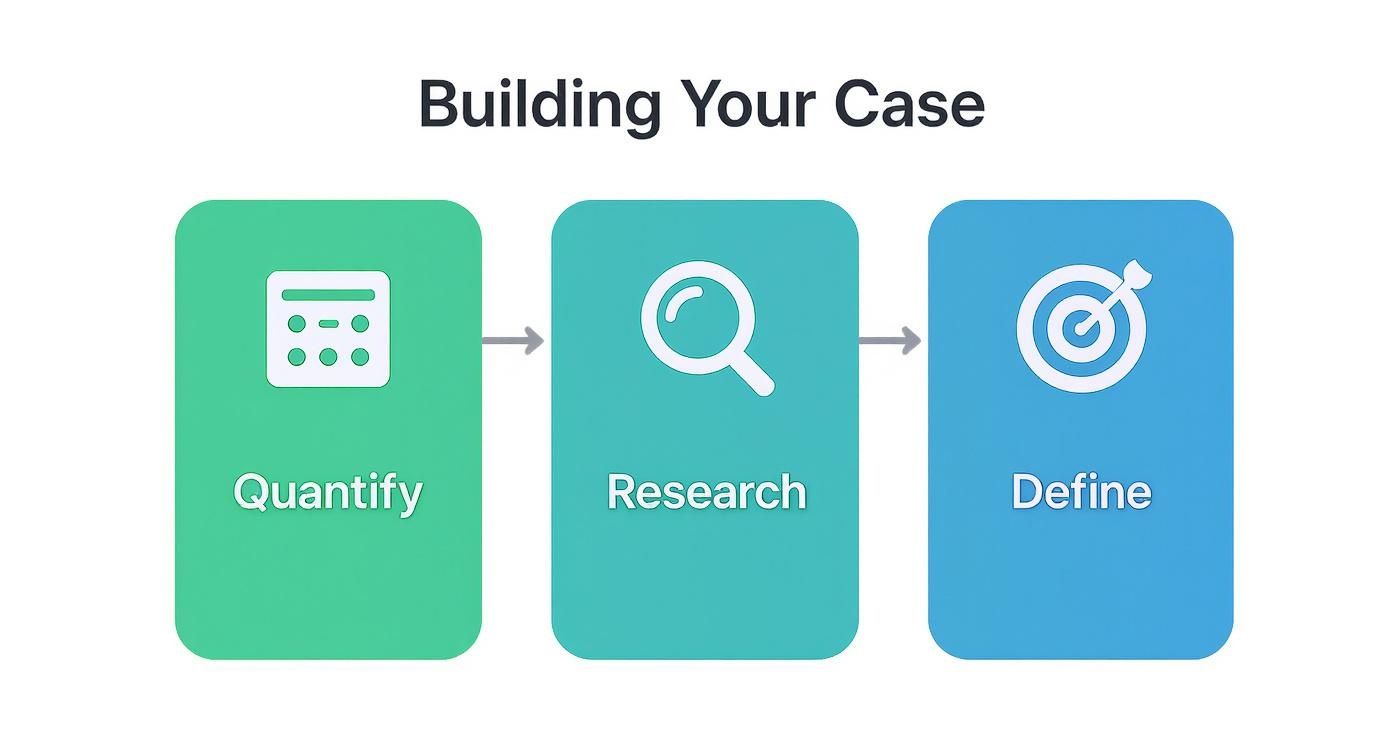
This visual reinforces a key truth: a strong argument is built on quantifiable results, solid market research, and a clearly defined target.
Handling Objections and Expanding the Conversation
It’s normal to hear objections like, "That’s not in the budget." Don’t let it throw you. An objection isn’t a "no" it’s an invitation to start problem-solving like a leader.
If they can’t move on base salary, it’s time to pivot.
Example Pivot:
"I understand the constraints on base salary. Given that, could we explore other areas of the compensation package to bridge the gap? I’m particularly interested in performance-based bonuses, a review cycle at six months, or an increased professional development budget."
This move shows you’re flexible and focused on a win-win outcome. You are building a holistic package that reflects your total value.
Think beyond the base. Other negotiable elements include:
Performance Bonus: Propose a bonus tied to specific, measurable outcomes.
Equity or Stock Options: Highly relevant in startups or publicly traded companies.
Professional Development: A budget for certifications, coaching, or key conferences.
Title Adjustment: Sometimes a title bump (e.g., from Senior Manager to Director) can be negotiated.
Additional Paid Time Off: An incredibly valuable non-monetary benefit.
Successfully negotiating salary with promotion is a career-defining skill. Talent often wins. Recent data from Resume Genius shows that a remarkable 79%of people who negotiated received a better offer. You can dig into the specifics in these salary negotiation trends and insights.
With a clear majority of employers open to discussion, your chances are strong. By staying calm, collaborative, and focused on the total value exchange, you reinforce the very leadership qualities that earned you the promotion.
Securing Your Offer and Embodying Your New Value
That verbal "yes" feels incredible. A victory. But and this is important it’s not the finish line. It is the start of the final phase: turning that handshake agreement into a rock-solid contract and integrating this new level of value into how you see yourself.

This last step is about locking in every detail without ambiguity. It’s also about allowing yourself to fully step into the leadership identity you just fought for. The job isn’t done until the ink is dry and you’ve internalized this win as your new professional baseline.
From Conversation to Contract
A verbal agreement is built on goodwill. A written one is built on clarity. It is non-negotiable that you get an updated offer letter or formal, written confirmation. This document is your proof, and it protects both you and the company.
When that email lands, resist the temptation to skim it and sign. Review it with the same meticulous attention you gave your research. Your only job is to verify every detail has been captured accurately.
This review isn’t about distrust; it’s standard business practice. Its purpose is to prevent future misunderstandings that breed resentment.
Take a deep breath. Go through it line by line. This is your final quality control checkpoint.
The New Offer Letter Checklist
Be systematic. Look for specific line items and make sure the numbers, language, and dates all match your final agreement. It's infinitely easier to fix a clerical error now than to renegotiate a signed contract later.
Here’s exactly what to look for:
Official Title: Is the titleexactlywhat was agreed upon?
Base Salary: Is the new annual base salary number correct, down to the last dollar?
Effective Date: When do the new title and salary officially kick in?
Bonus Structure: Is the performance bonus potential clearly defined?
Equity/Stock Options: Are the number of shares, vesting schedule, and grant date specified?
Other Compensation: Are all extras included? Professional development budgets, signing bonuses, or additional PTO should be in writing.
If you spot an error, don’t panic. A simple, non-confrontational email is all it takes. For example: "Thanks for sending this over. I was reviewing the details and noticed the base salary is listed as $X, but my understanding from our conversation was that we agreed on $Y. Could you please clarify?"
Embodying Your Win
Once the contract is signed, the final piece is internal. A successful salary negotiation is a profound psychological update. You just recalibrated how your organization values your contribution. Now, it's time you did the same for yourself.
Let this achievement rewire your sense of professional worth. This was not luck. This was not a favor. This was the direct result of your preparation, confidence, and ability to articulate your value. This is your new standard.
This process is about cementing a new leadership identity. Each time you successfully advocate for yourself, you strengthen your belief in your own agency. It's a foundational step in reclaiming your self-worth without guilt and owning the fact that you are the architect of your career.
Let this win settle into your bones. Feel the grounded confidence it brings. This success is now part of your story a cornerstone of the leader you are becoming.
Nailing the Tricky Questions
Even with a rock-solid plan, a few curveball questions can throw you off. That's normal. Getting comfortable with these sticking points is the final layer of preparation. It’s what keeps you grounded and in control.
Let's walk through the questions that pop up most often.
What if They Ask Me for a Number First?
Classic advice says to let them make the first offer. But sometimes, you're put on the spot. Don't panic. This is an opportunity to anchor the conversation high.
State your ideal number with confidence, but frame it around the market rate for the role's bigger scope. It's not about what youwant; it's about what therole is worth.
Try this: "Based on my research into the responsibilities of this new role and the market data for similar positions, I’m targeting a salary in the range of [$Ideal Number]to[$Slightly Higher Number]." This shows you’ve done your homework and immediately bases the discussion on data, not feelings.
How Big of a Raise Should I Actually Expect?
There’s no magic number, but a promotion deserves a significant bump, not just a token cost-of-living adjustment. For most internal promotions, you’re looking at an increase between 10% and 20% of your current salary.
But, and this is a big but, that figure can go much higher if your responsibilities are expanding dramatically. If you're moving from an individual contributor to leading a team, or from manager to director, your case for an increase well above 20% is strong.
Your negotiation must be focused on the market value of thenewrole, not a percentage increase on your old salary.
Your past salary is irrelevant. The only numbers that matter are the market value for this new position and the quantifiable impact you’re ready to deliver.
Is It Awkward to Negotiate as an Internal Hire?
Not awkward it's critical. Many women feel they should just be grateful for the internal promotion. This is a limiting belief that holds you back. The company chose you because you were the best person for the job. Theyexpectyou to step into this role as a leader, and leadership is knowing and advocating for your value.
The data backs this up. New research shows that 79% of people who negotiated received a better offer. The success rates are sky-high for those who are prepared. You can dig into the specifics in these salary negotiation trends and insights.
What if They Say, "There's No Room in the Budget"?
This is the most common objection, but it's rarely a dead end. Think of it as an invitation to problem-solve, not a hard "no."
When you hear this, shift into collaborative language. Try, "I understand the budget constraints. Given that, can we explore other ways to structure the compensation package to better reflect these new responsibilities?"
This is your signal to pivot the conversation beyond base salary. Now you can bring up other valuable parts of the package:
A guaranteed performance bonus
An upgraded title (e.g., Senior Director instead of Director)
A larger professional development budget
More paid time off or flexible work arrangements
By showing you’re flexible and focused on a solution, you reinforce the exact strategic leadership qualities that got you this promotion.
At Baz Porter, we help high-achieving women move from reactive anxiety to grounded, embodied leadership. If you're ready to stop second-guessing your worth and start architecting a career that honors your true value, explore our executive transformation programs at https://bazporter.com.

Voted number #1 for Leadership by the Best of the Best 2024. Real growth for High performing women who love life & demand more.
⭐⭐⭐⭐⭐
1630 30th Street Ste A - 418
Boulder Colorado 80301
United States
Phone: +1-646-212-4807
CUSTOMER CARE
NEWS
LEGAL


© 2019 - 2025 | Baz Porter LLC. All rights reserved.
Protected by all the possible laws. If you wanna try and copy it. We are gonna come after you. Liam Neeson Style.
Terms Of Use | Privacy Policy | Disclaimer